
Chinese Size to US, EU & UK Conversion Charts (2026) — Clothing, Shoes & Rings
Convert Chinese sizes to US, EU & UK for clothing, shoes, and rings. Quick charts, fit tips, and measurement guides for every category. Updated for 2026.
Your customer ordered a ring. You listed it as US size 7. The ring arrived — wrong size. Now you have a return request and a 1-star review.
This is one of the most common sizing mistakes in cross-border ring sales. Chinese ring sizes use a completely different system. A Chinese size 12 is NOT a US size 12. They are not even close.
This guide gives you the exact conversion chart — and shows you how to verify sizes before your next order ships. For a quick overview of all Chinese sizing categories — clothing, shoes, and rings — see our Chinese size to US/EU/UK master guide.
Here is the main conversion table you need before listing any ring sourced from a Chinese supplier. It covers the four major sizing systems your customers use — US, UK, EU, and China Mainland.
Before you use the table, here are two terms you will see throughout:
Inside Diameter: This is the straight line across the empty hole in the middle of the ring. You measure it from one inside wall to the other inside wall.
Inside Circumference: This is the total distance all the way around the empty hole of the ring. Think of it like taking a string, making a circle with it, and then pulling it flat to see how long it is.
Where do these numbers come from?
The millimeter (mm) numbers in this table come from the ISO 8653:2016 rule. This is the official world rule that says we measure rings by inside circumference in millimeters. The sizes for the US, UK, EU, and China are matched to these mm numbers using standard jewelry math.
| Inside Circumference (mm) | Inside Diameter (mm) | China Mainland | US Size | UK Size | EU Size |
|---|---|---|---|---|---|
| 46 | 14.6 | 6 | 3¾ | G½ | 46 |
| 47 | 15.0 | 7 | 4 | H | 47 |
| 48 | 15.3 | 8 | 4½ | I | 48 |
| 49 | 15.6 | 9 | 4¾ | I½ | 49 |
| 50 | 15.9 | 10 | 5¼ | J½ | 50 |
| 51 | 16.2 | 11 | 5½ | K | 51 |
| 52 | 16.6 | 12 | 6 | L | 52 |
| 53 | 16.9 | 13 | 6½ | M | 53 |
| 54 | 17.2 | 14 | 6¾ | M½ | 54 |
| 55 | 17.5 | 15 | 7¼ | N½ | 55 |
| 56 | 17.8 | 16 | 7½ | O | 56 |
| 57 | 18.2 | 17 | 8 | P | 57 |
| 58 | 18.5 | 18 | 8¼ | P½ | 58 |
| 59 | 18.8 | 19 | 8¾ | Q½ | 59 |
| 60 | 19.1 | 20 | 9 | R | 60 |
| 61 | 19.4 | 21 | 9½ | S | 61 |
| 62 | 19.7 | 22 | 9¾ | S½ | 62 |
| 63 | 20.1 | 23 | 10¼ | T½ | 63 |
| 64 | 20.4 | 24 | 10½ | U | 64 |
⚠️ “China Mainland” column follows the Mainland China standard. UK sizes follow the BSI 1987 standard. All mm values sourced from ISO 8653:2016.
A quick note: This chart works well as a reference, but factory sizes across Chinese factories can vary by ±0.5 mm. If you are between two sizes on a customer inquiry, suggesting the larger size is generally the more practical recommendation.
DailyFulfill Pro Tip: Based on our fulfillment data across multiple jewelry dropshipping clients, sizing errors are always one of the top reasons for returns in the jewelry category — often ranking above issues like scratched surfaces or broken clasps. The fix is not expensive. It just requires the right information on your product page.
When you sell rings online, you might list a product as “US size 7” for your customers. Your supplier in China reads that request and ships their size 7 — which has an inside circumference of 47 mm. On the conversion chart above, that is a US size 4. Your customer ordered a US 7 and received something three sizes too small.
The reason is simple. You and your factory in China are using two different measuring tools.
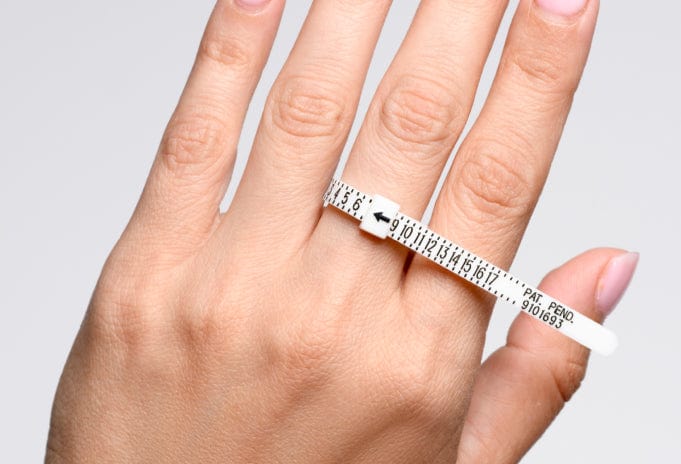
In the US, jewelry shops use a tool called a Ring Mandrel. (What this means: A Ring Mandrel is a long, metal stick shaped like a cone. You slide the ring down the stick to see its size.) This stick measures the inside diameter. (What this means: Inside diameter is the straight line from one side of the empty ring hole to the other side.) Because it only measures this short straight line, US sizes use small numbers like 3, 4, 5, or 6.
In China, factories use a tool called a Ring Gauge Set. (What this means: A Ring Gauge Set looks like a big keychain holding many small, heavy metal rings. You put your finger inside these small rings to find the right fit.) This tool measures the inside circumference. (What this means: Inside circumference is the total length all the way around the empty ring hole. Think of taking a string around the hole, then pulling the string flat to measure it with a ruler.) Because Chinese tools measure the whole circle, their sizes use bigger numbers like 7, 12, 14, or 17.
There is an official world rule book for ring sizes called ISO 8653:2016. (What this means: This is the global standard that tells jewelry makers how to measure rings.) This rule says that ring sizes should use the inside circumference in millimeters (mm).
This rule is why European (EU) sizes and Chinese sizes often work together — they both measure the full circle. But the US system uses the straight line across. This is why a US size number typically looks very different from an EU or Chinese number — they are measuring two different things.
Why this gap exists and why it matters for your supply chain (What this means: Supply chain is how you get products from a factory to your buyer.)
The Mainland China rule uses the inside circumference. In this system, the sizes are numbers in order — 4, 5, 6, 7, and so on. Each size goes up by 1 mm in inside circumference.
The Hong Kong size (HK Size) is different. It is very close to the Japan JIS rule. Because they use a different number system, an HK size and a Mainland size can be 1 or 2 numbers apart, even for the exact same ring.
This is a significant issue when you source from websites like AliExpress or 1688. Many factories in places like Guangdong, Shenzhen, or Hong Kong use the HK Size. But they often do not write this on their product page. You might order a size 14 thinking it is the Mainland size. The factory sends their size 14, which is the HK size. Because the two sizes are not the same, your buyer may receive a ring that does not fit as expected — and in most cases, they will not know why.
Here is a table to show the difference:
| Inside Circumference (mm) | China Mainland Size | HK Size |
|---|---|---|
| 46.0 | 6 | 7 |
| 47.0 | 7 | — |
| 47.5 | — | 8 |
| 48.0 | 8 | 9 |
| 49.0 | 9 | — |
| 50.0 | 10 | — |
| 50.5 | — | 10 |
| 51.0 | 11 | — |
| 52.0 | 12 | 11 |
| 53.0 | 13 | 12 |
| 53.5 | — | 13 |
| 54.0 | 14 | — |
| 55.0 | 15 | — |
| 55.5 | — | 14 |
| 56.0 | 16 | — |
| 56.5 | — | 15 |
| 57.0 | 17 | 16 |
| 57.5 | — | 17 |
| 58.0 | 18 | 18 |
| 59.0 | 19 | 19 |
| 60.0 | 20 | — |
| 61.0 | 21 | 20 |
| 62.0 | 22 | 21 |
| 63.0 | 23 | — |
| 63.5 | — | 22 |
| 64.0 | 24 | 23 |
| 66.0 | — | 24 |
As you can see, if a ring has an inside circumference of 54.0 mm, it is a size 14 in Mainland China, but a size 13 in Hong Kong. Before placing an order, it is worth confirming with your supplier which size chart they use.
🚩 Red Flag: If your supplier is based in Guangdong, Shenzhen, or ships from a Hong Kong warehouse, ask them directly before ordering: “Do you use Mainland China sizing or HK sizing?” Do not think they follow the same standard as your previous supplier — even factories in the same city can use different systems.
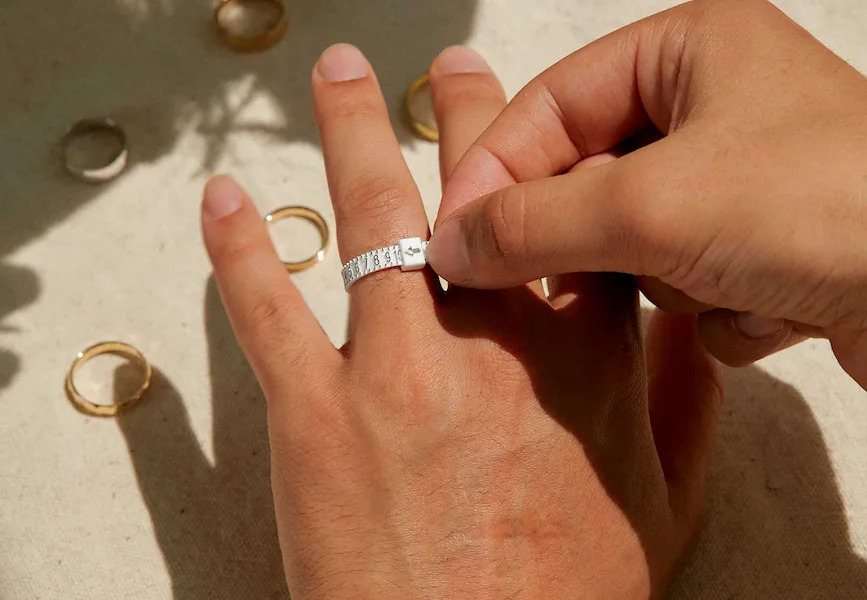
When you source rings from Chinese websites, the size charts can be wrong. Here is how to read them correctly before you place an order.
Watch out for two common mistakes when sourcing from AliExpress.
Mistake 1: Sometimes, a seller writes “US Size 7.” But they actually send a Chinese Size 7. A Chinese Size 7 has an inside circumference of 47 mm — which corresponds to approximately US Size 4, not US Size 7. That is a three-size difference. If you list this as US 7 and send it to your customer, it is very likely to be the wrong size.
Mistake 2: The product page only shows size numbers (like 7, 8, or 9). It does not show the size in millimeters (mm).
What you should do: Look for the words “Inner Diameter” or “内径.” (What this means: Inner Diameter is the straight line across the empty hole in the middle of the ring.) If you find the diameter in mm, you can multiply it by 3.14. This gives you the inside circumference. Then, look at the master chart in this article to find the correct US, UK, or EU size for your listing.
1688.com connects you directly to factories. But everything is written in Chinese. You need to look for specific Chinese words.
Look for these words on the page:
Once you find the mm number, use our master chart to find the correct US, UK, or EU size for your listing. Do not put the Chinese number directly on your own website. Your buyers will not understand it, and they may order the wrong size.
Temu looks very clean and has a simple UI. (What this means: UI stands for User Interface. It just means how the website looks and how easy it is to click on things.) Many Temu pages already show US sizes. But remember, the rings still come from Chinese factories.
It is a good idea to check the sizes yourself. Try to find the mm numbers to confirm they match the US size shown on the page.
If the seller does not show the mm numbers, it is worth reaching out to ask. Send them this message: “Can you confirm the inner circumference in mm for each size?” This is one of the more reliable ways to verify what you are ordering.
Taobao is one of the largest shopping platforms in China, but it is aimed at Chinese buyers. Everything on the page is in Chinese, and sizes follow the Mainland China standard.
When you browse Taobao for rings to sell, treat every size number as a Mainland China size — not a US or EU size. Look for the same fields you search for on 1688:
One thing to keep in mind with Taobao: many sellers are small individual shops and may not have a detailed size chart at all. If you cannot find mm data on the product page, send the seller a message through the platform’s chat tool. Most sellers respond to sizing questions fairly quickly.
💡 DailyFulfill Pro Tip: The single most reliable step you can take before listing any ring is to ask your supplier for the inside circumference in mm for every size. One number removes most of the guessing. If a supplier cannot or will not provide this data, that is worth a reason to find a different factory whether to work with them.
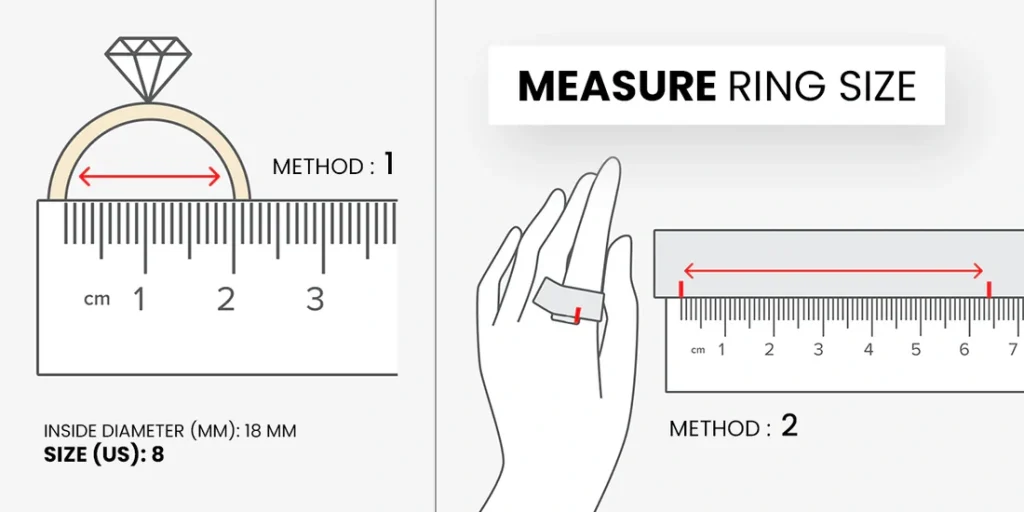
You can put these simple steps on your store’s “Size Guide” page. You can also share them with your customer service team. When buyers know how to measure their own fingers, they will ask fewer questions, and you will receive fewer sizing complaints.
This is the most precise way to find a size.
Take a straight ruler. Measure the inside diameter of a ring that already fits well. (What this means: The inside diameter is the straight line across the empty hole inside the ring, from one side to the other.)
Write down that number in millimeters (mm). Then multiply your mm number by 3.14. (In math, 3.14 is an approximation of Pi, a fixed number used for calculating circles. Using 3.14 works well for ring sizing — the difference from the exact value is less than 0.1 mm.)
For example, if your inside diameter is 16 mm: 16 × 3.14 = 50.24 mm.
This new number (50.24 mm) is your inside circumference. Now, look at the master chart in this guide to find your size.
People often ask: “How to measure ring size at home without a printer?” The answer is the paper method. You only need a piece of paper, a pen, and a straight ruler.
Here are the steps:
This mm length is your inside circumference. Take this number and check our size chart.
You can find a free ring sizer picture on the internet and print it on paper. You just cut it out and wrap it around your finger to read the number.
One important step to check: when you print the page, make sure to set your printer to “actual size” or “100% scale.” Do not let the printer resize the image to fit the paper. Even a small change in print scale can change your measurements by one size or more — so it is worth double-checking the print settings before using the sizer.
Sometimes a customer measures their finger, but the ring still feels wrong. This happens because fingers change size naturally. You can use these four points to answer customer emails. This helps explain why a ring feels tight or loose, and gives you a way to help them find the right fit instead of returning the item.
Fingers are usually smaller in the morning after waking up. They get bigger as the day goes on. By the evening, fingers are at their thickest. Tell your customers to measure their fingers in the late afternoon or evening. If they measure in the early morning, they might choose a size that is too small for the rest of the day.
Cold air makes fingers get smaller. (What this means: The skin and blood vessels pull in, making the finger smaller.) Hot air makes fingers expand and get bigger. If a customer is buying a ring during cold winter weather, you can suggest they add half a size — for example, going from a size 7 to a 7.5. This gives the finger a little extra room when they move into a warmer space.
(What this means: The knuckle is the hard bone joint in the middle of the finger.) Some people have a knuckle that is much wider than the base of their finger. If they pick a size based only on the base, the ring may not slide over the bone.
Tell these customers to try this:
This gives them the average. Choosing this average size helps the ring slide over the knuckle while keeping a reasonable fit at the base.
(What this means: The band width is how wide the metal part of the ring is.) Wide rings cover more skin on the finger. Because of this, a ring wider than 6 mm will generally feel tighter than a thinner ring at the same size.
If you are selling a wide ring, consider adding a clear note on your product page: “This is a wide ring. We suggest choosing half a size bigger for a more comfortable fit.”
When you sell rings to buyers in other countries, size problems can cost you money. These tips can help reduce returns and make the shopping experience clearer for your buyers.
Show all sizes and mm together
Buyers get confused if they only see one country’s size. It helps to show the US size, the UK size, the EU size, and the millimeters (mm) together on your product page. This helps buyers from Europe or America find their right size quickly without needing to contact you.
Use pictures, not just words
Do not just write the sizes in text. Put a clear size guide picture directly on your product page. A picture is easier for buyers to follow. This simple step can help lower the number of complaints about wrong sizes.
Tell them to size up
If a ring is wider than 6 mm, it is worth adding a note on your product page — for example: “This ring is wide. We suggest choosing half a size bigger.” You can also share a general tip with all buyers: “When in doubt, size up.” (What this means: If a buyer cannot decide between two sizes, they should pick the bigger one.) A ring that is slightly loose is generally easier to manage than one that is too tight to put on comfortably.
Check sizes for every new supplier
Every time you work with a new factory or introduce a new ring style, it is strongly worth checkin agin the mm sizes. Do not use the size chart from a previous supplier for a new product. Different factories use different molds to make their rings. (What this means: A mold is the metal shape used to form the hot metal into a ring. Different molds can mean slightly different sizes.)
This principle applies across all product categories — rings, clothing, and shoes all require per-supplier verification. For the full sizing framework, see our Chinese size conversion hub.
Before you add a new ring product to your website, work through these points:
Here are the most common questions buyers and sellers ask about ring sizes.
US Size 7 = China Mainland Size 17. Inner circumference ≈ 56.6mm, inner diameter ≈ 18.0mm
No. China measures by inner circumference (mm); the US uses a number scale derived from inner diameter. They are different systems — a Chinese Size 17 equals US Size 7, not US Size 17.
Find the EU number in the master chart above and read across to the US column. EU 52 = US 5½; EU 57 = US 7.
Wrap a thin strip of paper around the finger, mark where it overlaps, then measure the length in mm — that’s the inner circumference. Find it in the chart above. No printer needed.
This is the most confusing situation. Check the product description for millimeter measurements. If there are no mm measurements, message the seller and ask: “What is the inner diameter in mm for size 8?” The answer will tell you which system they are using. Do not guess.
Learn dropshipping tips, sourcing strategies and fulfillment insights from DailyFulfill
Convert Chinese sizes to US, EU & UK for clothing, shoes, and rings. Quick charts, fit tips, and measurement guides for every category. Updated for 2026.
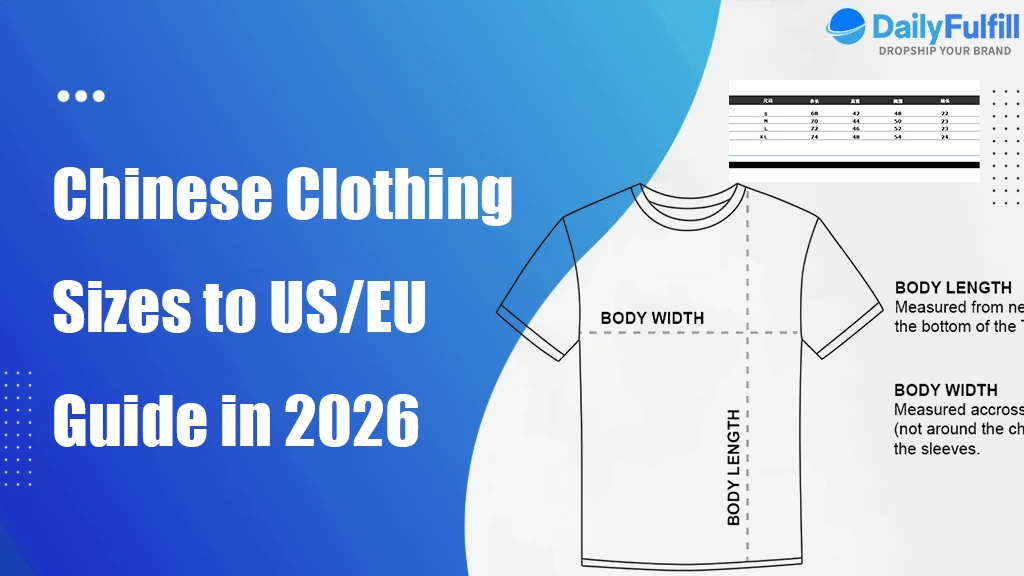
Chinese clothing sizes can cost you refunds. Use our size conversion charts, learn to decode 160/84A supplier tags, and avoid the ‘Free Size’ trap — with tips built for dropshippers and online sellers.
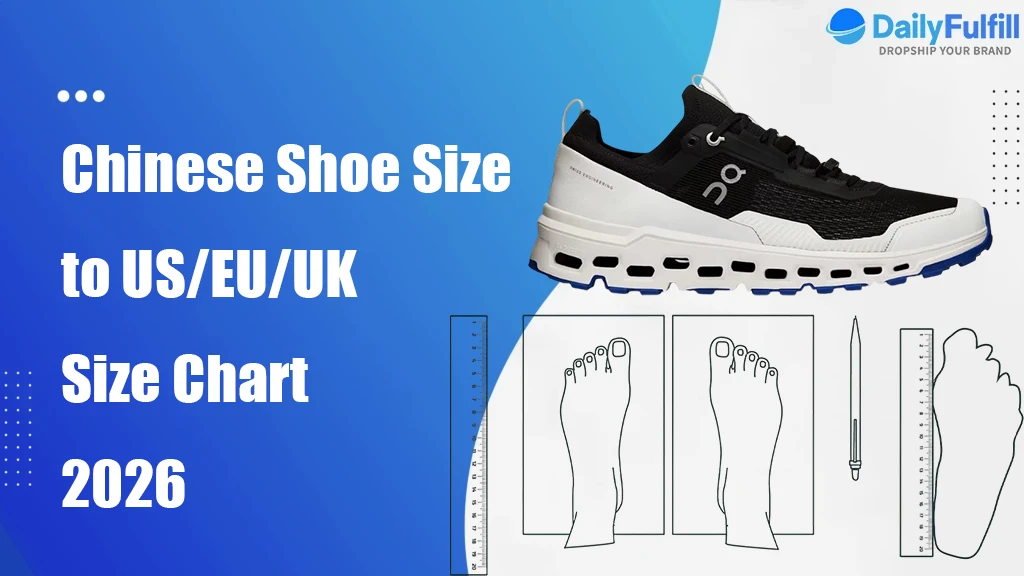
Convert Chinese shoe sizes to US, EU & UK with formula-verified charts for men, women & kids. Learn why CN ≠ EU, how to measure your feet, and what to ask the seller before you buy. Based on GB/T 3293.1 & ISO 9407