
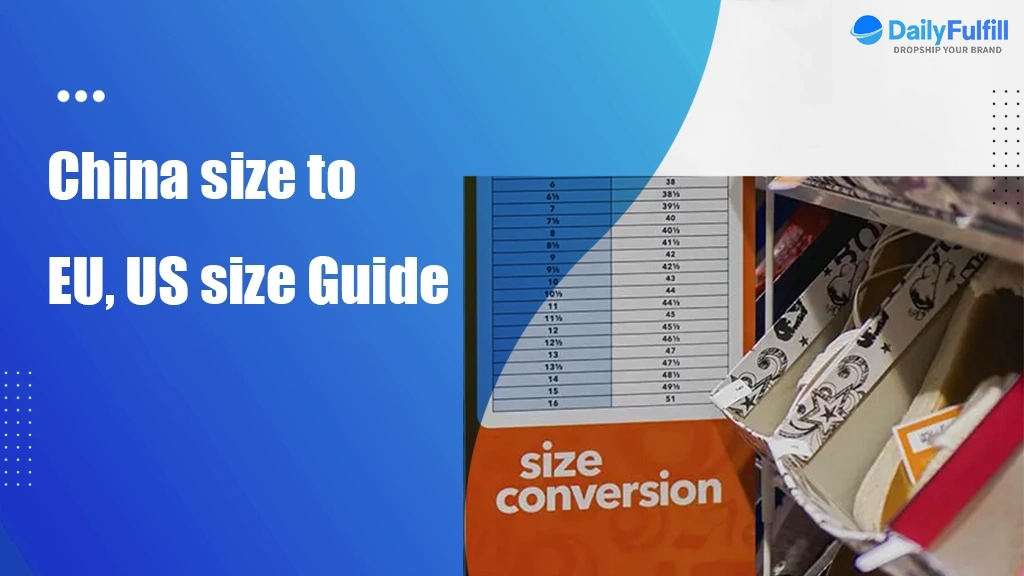
Chinese Size to US, EU & UK Conversion Charts (2026) — Clothing, Shoes & Rings
Convert Chinese sizes to US, EU & UK for clothing, shoes, and rings. Quick charts, fit tips, and measurement guides for every category. Updated for 2026.
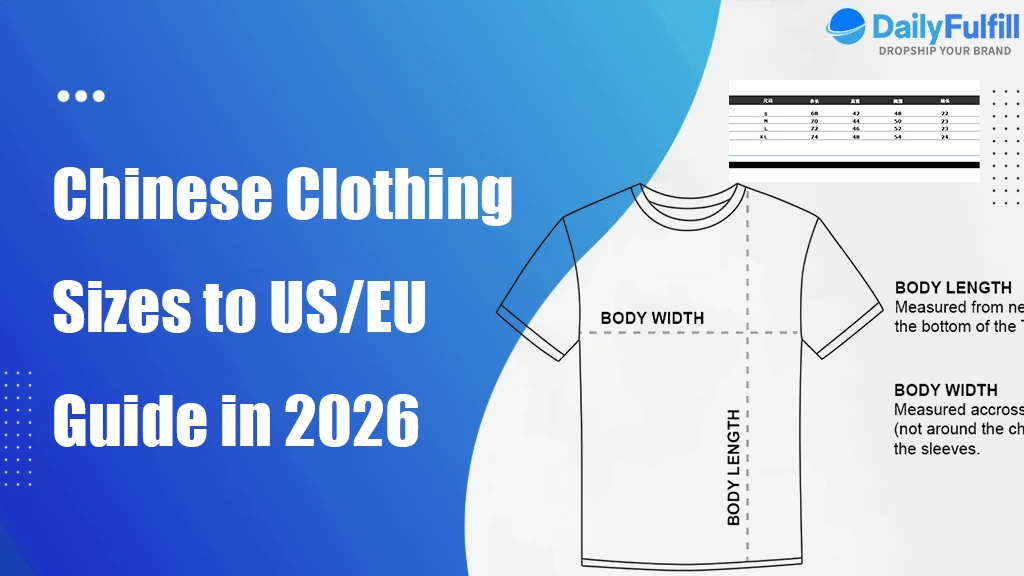
Picture this. You find a solid hoodie on 1688. The supplier says, “XL, don’t worry.” You list it on your Shopify store. Orders come in. Then the emails start.
“This XL fits like a medium.”
“I can barely zip it up.”
“I want a refund.”
Three chargebacks later, your Stripe account gets a warning. Not because your product was bad — but because the sizing was wrong. And you didn’t even know it was wrong until your customers told you.
Here’s what most dropshippers get wrong about Chinese clothing sizes: they think it’s just “one size smaller.” So they tell customers to size up, and call it a day. But that’s only part of the story. Chinese manufacturers often use a completely different sizing system — tags like 160/84A — that most sellers outside of China have never seen before. On top of that, many suppliers list items as “Free Size” (均码), which sounds flexible but usually only fits a narrow range of Asian body types. If you sell those items to US or European customers without clear measurements on your product page, returns are almost sure to happen.
That’s what this guide is for. Inside, you’ll get the size conversion charts (men’s, women’s, and kids’). But more importantly, you’ll learn how to actually read a Chinese supplier’s size tag, how to handle “Free Size” products without getting burned, and how to set up your product page so your customers pick the right size before they order — not after.
One more thing before we start. This isn’t a guide we wrote by Googling other size charts. At DailyFulfill, we process thousands of clothing orders from Chinese suppliers every month. Our QC team measures garments, catches size mismatches, and flags problems before packages leave the warehouse. What you’ll read here comes from what we see — and fix — on the warehouse floor every day.
For a quick overview of all Chinese size categories — including shoes and rings — see our master Chinese size conversion guide.
Let’s start with what you probably came here for: the charts.
Below are three conversion tables — women’s, men’s, and children’s. But unlike most size charts you’ll find online, ours include a CN Tag column. That’s the tag format (like 160/84A) you’ll actually see on garments from Chinese suppliers and on 1688 product listings. If you’ve ever received samples with confusing number-letter tags, this column helps you match them to familiar US, UK, and EU sizes.
A quick note before you use these tables: Sizing can vary between manufacturers, even within China. These charts are based on the general ranges used across the Chinese garment industry, matches the GB/T 1335 national sizing standard. Treat them as a reliable starting point — but always confirm with your specific supplier’s measurements before listing a product.
| Chinese Label | CN Tag | US Size | UK Size | EU Size | Bust (cm) | Waist (cm) | Hips (cm) |
|---|---|---|---|---|---|---|---|
| S | 155/80A | 0–2 | 4–6 | 32–34 | 78–82 | 62–66 | 86–90 |
| M | 160/84A | 4–6 | 8–10 | 36–38 | 82–86 | 66–70 | 90–94 |
| L | 165/88A | 8–10 | 12–14 | 38–40 | 86–90 | 70–74 | 94–98 |
| XL | 170/92A | 10–12 | 14–16 | 40–42 | 90–94 | 74–78 | 98–102 |
| XXL | 175/96A | 12–14 | 16–18 | 42–44 | 94–98 | 78–82 | 102–106 |
How to read this: If your supplier sends you a women’s top tagged 160/84A, look at the M row. That garment is designed for someone about 160cm tall with an 84cm bust and a standard (“A”) body shape. In US sizing, that’s roughly a size 4–6.
Notice how a Chinese XL lines up with a US 10–12? That’s closer to a US Medium or Large in many American brands. This is exactly why your customers complain that “the XL is too small.” It’s not wrong — it’s a different system.
| Chinese Label | CN Tag | US Size | UK Size | EU Size | Chest (cm) | Waist (cm) |
|---|---|---|---|---|---|---|
| S | 165/84A | XS–S | 34–36 | 44–46 | 82–86 | 71–76 |
| M | 170/88A | S–M | 36–38 | 46–48 | 86–90 | 76–81 |
| L | 175/92A | M–L | 38–40 | 48–50 | 90–94 | 81–86 |
| XL | 180/96A | L–XL | 40–42 | 50–52 | 94–98 | 86–91 |
| XXL | 185/100A | XL–XXL | 42–44 | 52–54 | 98–102 | 91–96 |
| 3XL | 190/104A | XXL+ | 46+ | 56+ | 102–106 | 96–101 |
Same pattern here. A Chinese men’s XL (180/96A) is roughly a US L. If your average American male customer orders an XL expecting the roomy American fit, they’ll likely find it tight — especially in the shoulders and arms. (We’ll explain that shape difference in detail later in this guide.)
Children’s sizing in China works differently from adults. Instead of S/M/L letters, most Chinese children’s clothing uses the child’s height in centimeters as the main size label. You’ll see tags like 110, 120, 130 — that number is the target height of the child in cm.
| Chinese Label (Height) | CN Tag | US Size | Age Range (Approx.) | Height (cm) | Chest (cm) |
|---|---|---|---|---|---|
| 100 | 100/52 | 3T–4T | 2–3 years | 95–105 | 50–54 |
| 110 | 110/56 | 4–5 | 3–4 years | 105–115 | 54–58 |
| 120 | 120/60 | 6–6X | 5–6 years | 115–125 | 58–62 |
| 130 | 130/64 | 7–8 | 7–8 years | 125–135 | 62–66 |
| 140 | 140/68 | 10–12 | 9–10 years | 135–145 | 66–70 |
| 150 | 150/72 | 14 | 11–12 years | 145–155 | 70–74 |
A note for sellers: The “Age Range” column is a rough guide, not a rule. Kids grow at different rates, and parents in different countries have different expectations. On your product page, always highlight the height and chest measurement in cm instead of relying on age. It reduces confusion and helps parents make better choices — which means fewer returns for you.
💡 Pro Tip
Stop guessing sizes and risking your Stripe account. DailyFulfill’s QC team lays your clothes flat on the table and measures the exact chest and shoulder width with a tape. We catch the wrong sizes in our China warehouse, pack them in your custom bags, and ship them out fast. No more ‘This XL is a Medium’ emails
If you’ve ever browsed 1688 or received samples from a Chinese supplier, you’ve probably seen tags like 160/84A or 170/92B on the garments. Most sellers outside China have no idea what these mean. They’re not random numbers — they’re actually a precise sizing code that tells you more about the fit than “S” or “M” ever could.
The problem? If you can’t read these tags, you can’t write an accurate product listing. And inaccurate listings lead to wrong expectations, wrong fits, and refund requests.
Let’s break it down.
Every Chinese size tag follows the same formula:
Height / Body Width + Body Shape Letter
That’s it. Three pieces of information packed into one short code. Here’s how to read each part:
Take the tag 170/92B as an example:
Here’s a quick reference for the body shape letters:
| Letter | Body Shape | What It Means in Plain English |
|---|---|---|
| Y | Very slim | Narrow chest/waist relative to height — a thin build |
| A | Standard | The most common fit — average proportions |
| B | Full | Wider chest/waist relative to height — a stockier build |
| C | Heavy | The roomiest cut — designed for larger body types |
Most garments you’ll find on 1688 are labeled “A” because that’s the standard body shape category in China. You’ll see “B” on some items marketed as loose fit or plus-size within the Chinese market. “Y” and “C” are less common.
Let’s do one more example to make sure it clicks:
160/84A → Made for someone who is 160cm tall, with an 84cm bust, and a standard (A) body shape. If you look at the women’s conversion table earlier in this guide, this maps roughly to a Chinese M, which is approximately a US 4–6.
💡 Quick mental shortcut: The first number (height) tells you how long the garment will be. The second number (bust/waist) tells you how wide it will be. The letter tells you the overall shape. Height = length. Measurement = width. Letter = shape.
Infographic suggestion for the design team: A simple visual showing a clothing tag with “170/92B” printed on it. Three arrows point from the tag to three labels: Arrow 1 → “170 = Height (cm)” / Arrow 2 → “92 = Chest (cm)” / Arrow 3 → “B = Body Shape (Full).” Keep it clean and easy to scan — this is the kind of image people will screenshot and save.
You might be thinking: “OK, interesting — but I just sell clothes in S/M/L on my store. Why do I need to know this?”
Here’s why: your supplier probably doesn’t think in S/M/L.
When you source clothing from Chinese manufacturers — especially through 1688, Taobao, or directly from factories — the sizing information you receive is often in this 160/84A format. Some suppliers add an S/M/L label as a courtesy for international buyers, but many don’t. And even when they do, their idea of “L” might not match your customer’s idea of “L.”
If you can read the CN tag, you can:
1. Write a more accurate product page. Instead of guessing what “Chinese XL” means in US sizing, you see 180/96A, check that it’s designed for a 96cm chest, and confidently list it as roughly a US L–XL with the exact cm measurements included.
2. Catch sizing problems before they reach your customers. If a supplier sends you garments tagged 165/88A but you ordered what you thought was an XL, you can immediately see there’s a mismatch — 165/88A is a Chinese L, not an XL.
3. Compare products across different suppliers. Supplier A’s “XL” and Supplier B’s “XL” might not be the same size. But if Supplier A’s tag says 175/96A and Supplier B’s says 180/100A, you know exactly how they differ — and you can adjust your listings accordingly.
Where does this system come from? It’s not something suppliers made up on their own. This sizing format is defined by China’s national standard GB/T 1335, a set of official guidelines published by the Standardization Administration of China. The standard is split into three parts: GB/T 1335.1 covers men’s garments, GB/T 1335.2 covers women’s, and GB/T 1335.3 covers children’s. It requires clothing sizes to be based on actual body measurements (height, bust/waist) and a body shape classification — which is why you see tags like 170/92B instead of just “Large.”
Not every manufacturer follows the standard perfectly. Small factories may round numbers or skip the body shape letter. But the format is widely used across China’s garment industry, and understanding it gives you a major advantage when communicating with suppliers and building your product pages.
The bottom line: S/M/L labels are vague. The CN tag system is specific. As a seller, specific numbers help you write better listings, catch errors early, and reduce the size-related returns that eat into your profit margins.
If you’ve spent any time browsing 1688 or Taobao for clothing to sell, you’ve seen these two words everywhere: 均码 (jūn mǎ). The English translation on most listings is “Free Size” or “One Size Fits All.”
It sounds great in theory. One SKU, no size variants to manage, simpler inventory. For a dropshipper, it looks like the easy path.
It’s actually a trap. And it’s one of the most common reasons clothing sellers get hit with a wave of returns they never saw coming.
“Free Size” does not mean the garment stretches to fit everyone. It means the manufacturer made the garment in one single size and decided not to assign it an S, M, or L label.
In practice, that one size is designed to fit the average Chinese female body type. That typically covers a bust range of roughly 80–88cm and a waist of about 62–70cm. In US sizing terms, that’s approximately an XS to M.
You’ll see “Free Size” most often on:
Because these items use soft or stretchy materials, they can accommodate a small range of body sizes. But that range is much narrower than most Western customers expect when they read “One Size Fits All.”
Think about your customer base. If you’re selling to the US or Europe, a significant portion of your buyers will be US size L or above. According to data from the CDC’s National Health and Nutrition Examination Survey, the average American woman has a waist circumference of approximately 98cm (about 38.7 inches). That’s well outside the 62–70cm range that most “Free Size” garments are built for.
So here’s what happens:
One or two cases? Manageable. But if “Free Size” items make up a big chunk of your catalog and you haven’t adjusted your listings, those returns can add up fast.
You don’t have to avoid “Free Size” products entirely. Some of them are genuinely good products with healthy margins. But you need to handle them carefully. Here’s a step-by-step approach:
Step 1: Get the actual measurements from your supplier.
The moment you see “均码” or “Free Size” on a product listing, message the supplier and ask for the specific measurements in centimeters. At minimum, you need: bust, waist, hips, and body length. For tops, also ask for shoulder width.
Don’t accept “it fits everyone” as an answer. You need numbers.
Step 2: Rewrite the listing on your store — never use “One Size Fits All.”
This phrase creates an expectation you can’t deliver on. Instead, replace it with the actual cm measurements and include the approximate Western size range. For example:
“This item is made in one size. Fits approximately bust 80–88cm / waist 62–70cm / hips 86–94cm. This is roughly equivalent to US XS–M or UK 6–10. Please check the measurements below before ordering.”
That’s honest. It’s specific. And it sets the right expectation before anyone clicks “Buy.”
Step 3: Add a sizing disclaimer to the product page.
A short, clear note can prevent a lot of confusion. Something like:
“This item uses Asian sizing and is designed to fit a specific measurement range. Please refer to the size chart and measure yourself before purchasing. If you are between sizes, we recommend choosing the larger option.”
This kind of language doesn’t scare customers away — it actually builds trust. It shows your store takes fit seriously. And more importantly, it gives you a clear reference point if a customer tries to dispute an order. You told them the exact measurements. They chose to buy.
🚩 Red Flag
If a supplier lists only “Free Size” with no measurements at all — no bust, no waist, no length, nothing — treat that as a warning sign. It often means they haven’t done proper sizing quality control on that product. The garment dimensions might vary from piece to piece because nobody’s checking.
Before you commit to ordering — especially in bulk — ask the supplier for flat-lay photos with a measuring tape visible in the shot. That means the garment is laid flat on a table and physically measured while you can see the tape in the image.
Better yet, if you work with a fulfillment agent, have them order a sample and measure it for you. At DailyFulfill, this is a standard part of our pre-order QC process. We measure the actual garment, compare it against the supplier’s claimed specs, and send you the real numbers before you build your listing. It’s a small step that can save you a lot of refund headaches down the line.
This is the part that confuses a lot of sellers — and their customers.
You’ve read the advice everywhere: “Chinese clothes run small. Just size up one or two sizes.” So your customer orders two sizes up. The chest fits fine. But the shoulders are too tight. The sleeves are too short. The jacket pulls across the upper back every time they reach forward.
They’re frustrated. They sized up like they were told. It still doesn’t fit. So they request a refund.
What went wrong? The size was right. But the shape was wrong.
This is the difference between Asian Fit and Western Fit — and it’s something most size charts completely ignore.
When we talk about clothing fit, most people focus on three numbers: chest, waist, and hips. Those are important. But a garment’s fit depends on more than just those three measurements. It also depends on how the garment is shaped — how the pattern is cut, where the seams sit, and how the fabric is distributed across the body.
Chinese manufacturers generally design their clothing around the average Asian body frame. Compared to the average Western body frame, this tends to mean:
Here’s a practical example to show why this matters:
Imagine you’re sourcing a men’s winter jacket from a Chinese supplier. The supplier’s size chart says the XL has a 104cm chest. You check a US sizing reference and see that a US Large also fits around 104cm chest. So you think, great — the Chinese XL is basically a US L.
But then you compare the other measurements:
| Measurement | Chinese XL | Typical US L |
|---|---|---|
| Chest | 104 cm | 104 cm |
| Shoulder width | 44 cm | 47–48 cm |
| Sleeve length | 62 cm | 65–66 cm |
| Armhole depth | 24 cm | 26–27 cm |
Note: The “Typical US L” figures above are approximate general ranges commonly seen in Western-fit brands — not a universal standard. Exact measurements vary by brand.
The chest is the same. But the Chinese XL jacket is roughly 3–4cm narrower in the shoulders and 3–4cm shorter in the sleeves. For your customer, that’s the difference between “fits well” and “feels tight across my back.”
This is why “just size up” doesn’t always solve the problem. Sizing up gives your customer more room in the chest and waist. But it doesn’t change the proportional shape of the garment. A Chinese XXL will have wider shoulders than a Chinese XL, yes — but the proportions are still built on an Asian Fit frame. The shoulders might still feel narrow compared to what a Western customer expects.
This doesn’t mean you can’t sell Asian Fit clothing to Western customers. Plenty of sellers do it successfully. But it means you need to set expectations clearly on your product page — and that starts with showing the right measurements.
If you sell clothing sourced from China — especially structured items like jackets, blazers, dress shirts, and coats — you need to go beyond the standard bust/waist/hips size chart. Here’s how:
1. Add shoulder width and sleeve length to your size chart.
These two measurements are the biggest predictors of fit complaints on Asian Fit garments. Yet most size charts on Shopify stores skip them entirely.
Your size chart should include at least these columns: Bust/Chest, Waist, Shoulder Width, Sleeve Length, and Body/Garment Length. For pants, add Inseam and Thigh Width as well.
2. Use garment measurements, not body measurements.
This is an important distinction that many sellers miss.
Garment measurements are more precise and more useful for your customers. They remove the guesswork. A customer can measure a shirt they already own, compare it to your flat-lay numbers, and know whether the fit will work for them.
When you message your supplier, ask specifically: “Can you send me the garment measurements (成衣尺寸), not the body measurements?” If they only provide body measurements, ask them to lay the garment flat and measure it. Most suppliers can do this — you just need to ask.
3. Add a fit note to your product description.
A single honest sentence can prevent a lot of returns. Something like:
“This item is made with an Asian fit, which tends to be slimmer through the shoulders and torso compared to Western sizing. If you prefer a more relaxed fit, we recommend ordering one size up.”
This doesn’t make your store look unprofessional. It makes it look informed. Customers appreciate transparency, and a clear fit warning is far better than a vague “size up” recommendation with no explanation.
💡 Pro Tip
Here’s a trick from our QC team at DailyFulfill: when we inspect clothing orders in our warehouse, we don’t just check the chest width. We measure shoulder seam to shoulder seam — the distance from where the sleeve meets the body on one side to the same point on the other side.
Based on what we see across thousands of orders, that one number predicts more fit complaints than any other measurement we track. A customer might tolerate a slightly snug waist. But tight shoulders? That’s the thing that makes a jacket feel “wrong” from the first five seconds of trying it on — and it’s the thing most likely to trigger a return.
If you only have time to double-check one measurement before listing a product, make it shoulder width.
The same shape mismatch applies to footwear — Chinese shoes are often built on narrower lasts. If you also sell shoes, see our Chinese shoe size conversion guide for the width details you need.
The best size chart in the world won’t help if your customer doesn’t know how to measure themselves. And honestly? Most people don’t. They guess. They pick the size that “sounds right.” Then the garment arrives, it doesn’t fit, and you get a return request.
That’s why a good size guide page on your store doesn’t just show a chart — it teaches your customer how to use it. Even a short, clear measurement guide can make a real difference in reducing size-related returns.
Below is a simple body measurement guide you can reference — or adapt directly onto your own Shopify store’s size guide page. We’ve kept the language plain and the instructions short so they work well for international customers whose first language may not be English.
These are the four measurements that matter most for clothing. Between them, they cover tops, bottoms, dresses, and most outerwear.
1. Bust / Chest
Wrap the measuring tape around the fullest part of your chest. For women, this is usually across the bust line. For men, it’s across the widest part of the pecs. Keep the tape horizontal all the way around — don’t let it dip or ride up at the back.
What it’s used for: Tops, shirts, jackets, dresses, bras.
2. Waist
Find your natural waistline. This is the narrowest part of your torso — usually about 2–3cm above your belly button. Wrap the tape around this point. Don’t suck in your stomach. Just stand normally and breathe naturally.
What it’s used for: Pants, skirts, shorts, high-waisted dresses, belts.
3. Hips
Stand with your feet together. Wrap the tape around the widest part of your hips and buttocks. This is usually about 18–23cm below your natural waistline, depending on your body type. Keep the tape level and snug.
What it’s used for: Pants, skirts, fitted dresses, shorts.
4. Inseam
This one’s for pants and trousers. The inseam is the distance from the crotch seam (where the inner leg seams meet) down to the bottom of the ankle bone. The easiest way to get this right is to measure a pair of pants you already own that fit well: lay them flat, and measure from the crotch seam straight down to the hem.
What it’s used for: Pants, trousers, jeans, leggings.
If you sell tops, jackets, or outerwear sourced from China, we strongly recommend including these two additional measurements on your size guide page. As we covered in the previous section, shoulder width and sleeve length are where Asian Fit garments differ the most from Western Fit — and they’re the measurements most likely to cause fit complaints if your customer doesn’t know what to expect.
5. Shoulder Width
This is the distance from one shoulder tip to the other, measured straight across the back. The shoulder tip is the bony point at the very edge of your shoulder, where the arm starts. If you’re measuring a garment instead of a body, it’s the distance from one shoulder seam to the other.
What it’s used for: Jackets, blazers, coats, structured tops, dress shirts.
6. Sleeve Length
Measure from the shoulder tip (the same bony point) down along the outside of your arm to your wrist bone. Keep your arm relaxed and slightly bent — not straight out to the side and not hanging stiffly.
What it’s used for: Long-sleeve shirts, jackets, blazers, coats.
Whether you’re teaching your customers to measure themselves or measuring garment samples in your own workspace, these small details make a big difference:
You don’t need to reinvent the wheel. Take the guide above, simplify it if needed, and put it on a dedicated “Size Guide” page on your Shopify store. Then link to it from every product page.
Some sellers include a shortened version directly on the product page itself — just the measurement diagram and the size chart — with a link to the full guide for customers who need more detail. Either approach works. The key is making sure the information is easy to find and easy to follow, so customers measure themselves before they order, not after the package arrives.
☑️ Seller Checklist: Size Chart Page for Your Store
Before you publish your next clothing listing, run through this list. It covers everything we’ve discussed in this guide so far. The more boxes you check, the fewer size-related returns you’re likely to deal with.
- Conversion table included — Chinese sizes mapped to US, UK, and EU equivalents
- All measurements listed in both cm and inches — don’t make customers do the math
- Garment measurements used, not just body measurements — the actual flat-lay numbers from the specific product you’re selling
- Shoulder width included for tops, jackets, and outerwear — the #1 fit complaint predictor for Asian Fit garments
- “Free Size” items explained with a specific cm range and approximate Western size equivalent — never just “One Size Fits All”
- “Asian Fit” disclaimer added where applicable — a short, honest note about the slimmer cut through shoulders and torso
- A note encouraging customers to measure themselves before ordering — even one sentence helps
- A visual diagram showing where to measure — or a link to a simple how-to-measure guide (like the one above)
Want a ready-made version of this checklist you can hand to your VA or listing team? At DailyFulfill, we share sizing QC templates with our clients as part of onboarding. Reach out to our team if you’d like a copy.
Yes, Chinese clothing generally runs 1 to 2 sizes smaller than US or European sizing.
(For the quick-reference rule across all product categories, see The #1 Rule: Chinese Sizes Run Smaller.)
A Chinese XL, for example, often fits closer to a US Medium or Large. But if you sell clothing online, the real issue isn’t just that the sizes are “small.” It’s that the cut and shape of Chinese garments are different from what Western customers expect — and a simple “size up” recommendation won’t always fix that.
Let’s unpack what that actually means for you as a seller.
The basic size difference is well known at this point. Chinese manufacturers design their garments around Chinese body proportions, which tend to run smaller than American or European averages. So yes, if your customer normally wears a US Large, they’ll likely need a Chinese XL or even XXL to get the same chest and waist room.
Most size chart guides on the internet stop right there. They tell the reader “just order 1–2 sizes up” and move on.
But if you’ve read the earlier sections of this guide, you already know that sizing up only solves part of the problem. Here’s a quick recap of the three deeper issues we covered:
1. Size labels don’t mean the same thing across suppliers.
A Chinese “XL” is not a universal measurement. It’s a label — and different manufacturers define it differently. One supplier’s XL might have a 100cm chest, while another’s XL measures 96cm. The only way to know what you’re actually selling is to look at the centimeter measurements, not the letter on the tag. And if your supplier uses the CN tag system (like 175/96A), you now know how to decode it.
2. “Free Size” products don’t fit everyone.
As we covered earlier, “Free Size” (均码) typically fits a narrow range — roughly an Asian XS to M, or about 80–88cm bust. If you list a Free Size item without specifying the actual measurements and the approximate Western size range it covers, you’re setting up a portion of your customers for disappointment. And disappointed customers don’t just move on — they file chargebacks.
3. The shape is different, not just the size.
This is the part most sellers overlook. Chinese garments are cut with narrower shoulders, shorter sleeves, and smaller armholes compared to Western-fit clothing at the same chest measurement. So even when a customer sizes up and the chest fits fine, the jacket might still feel tight across the upper back, or the sleeves might end above the wrist. Sizing up adds width, but it doesn’t change the underlying proportions of the garment.
You’ll see this line on a lot of Shopify stores that sell Chinese-sourced clothing: “Asian sizing — please order 1–2 sizes up.”
It’s well-intentioned. But it creates two problems:
First, it’s vague. Size up from what? A US size? A UK size? The customer’s usual Nike size? Their Zara size? Without a reference point, “size up” means something different to every person reading it. A customer who normally wears a US Small might size up to a Medium and still get the wrong fit, because the shape differences we discussed above aren’t solved by going one letter higher.
Second, it makes your brand look unpolished. Telling customers to “size up” signals that your sizing is off and you haven’t bothered to translate it properly. Compare that to a store that shows a clean, detailed size chart with actual garment measurements in both cm and inches, a clear note about the Asian Fit cut, and a short guide on how to measure. Which store feels more trustworthy?
The approach that leads to fewer returns and a more professional-looking store is straightforward:
Replace the vague “size up” note with precise measurements.
Instead of:
“This item uses Asian sizing. Please order 1–2 sizes larger than your usual size.”
Write something like:
“This item is designed with an Asian fit, which runs slimmer through the shoulders and torso compared to Western sizing. Please refer to the size chart below — all measurements are taken from the actual garment laid flat. We recommend measuring a similar item you already own and comparing it to our chart for the best fit.”
Then include a size chart with garment measurements (not just body measurements) that covers chest, waist, shoulder width, sleeve length, and body length — all in both cm and inches.
Is this more work than slapping a “size up” warning on the page? Yes. But it directly addresses the three problems we discussed — the inconsistent labels, the Free Size confusion, and the shape difference — in a way that a generic sizing disclaimer never can.
It’s also the approach most likely to protect your margins. Every return you prevent is money you keep. Every chargeback you avoid is one less strike on your payment processor account. And every customer who gets the right fit on the first try is more likely to come back and buy again.
Still unsure about your size? Go back to the measurement guide above, take your bust, waist, and shoulder width in centimeters, and compare them directly to the garment measurements on the seller’s product page — not the letter label.
If you are sourcing from 1688, Taobao, or AliExpress, ask the supplier for flat-lay measurements (成衣尺寸) for every size. One set of real numbers is worth more than any S/M/L label.
Buying clothing from China does not have to end in chargebacks. With the right measurements and a clear size chart on your product page, you can sell confidently — and keep your customers coming back.
Want to stop guessing and start scaling? DailyFulfill measures every garment in our warehouse, catches size mismatches before they ship, and packs your orders in custom branded packaging — not grey plastic bags.
Here are the most common questions buyers and sellers ask about ring sizes.
An Asian XL typically fits closer to a US Medium or Large. But this isn’t a hard rule. It depends on the brand, the manufacturer, and the type of garment. A Chinese XL t-shirt from one supplier might have a 100cm chest, while a Chinese XL from another supplier might measure 96cm.
The safest approach — whether you’re buying for yourself or listing items on your store — is to ignore the letter label and look at the actual centimeter measurements. Compare those numbers to a US size chart or, better yet, to a garment you already own that fits well.
This is a Chinese size tag that follows the national standard called GB/T 1335. It gives you three pieces of information:
The body shape letters range from Y (very slim) to A (standard) to B (full) to C (heavy). Most garments on the Chinese market use “A.”
In practical terms, a women’s garment tagged 160/84A is roughly a Chinese M, which maps to approximately a US 4–6. You can find the full breakdown in our conversion tables earlier in this guide.
The most reliable method is to compare actual body or garment measurements in centimeters rather than trying to match letter sizes directly. Here’s a simple process:
We don’t recommend simply “going up two sizes” as a conversion method. Chinese and US sizing systems aren’t offset by a fixed amount — the gap varies by brand, garment type, and body shape. The centimeter measurements are the common language between both systems, and they’re the most dependable way to find the right match.
No. A Chinese XL is usually closer to a US M or L in terms of chest and waist measurements. But the differences go beyond just the numbers.
Chinese garments are typically cut with an Asian Fit — meaning the shoulders tend to be narrower, the sleeves shorter, and the torso slimmer compared to a Western-fit garment with the same chest measurement. So even if the chest width on a Chinese XL matches a US XL, the overall garment may still feel tighter across the back and arms.
If you’re a seller, this is why showing shoulder width and sleeve length on your size chart matters — not just bust and waist.
“Free Size” (均码, or jūn mǎ in Chinese) means the garment is made in one single size — there are no S, M, L, or XL options. You’ll see it a lot on 1688 and Taobao, especially for women’s tops, knitwear, scarves, and items made from stretchy fabric.
Despite the name, “Free Size” does not mean it fits everyone. In practice, it usually fits a range of about bust 80–88cm and waist 62–70cm, which is roughly a US XS to M. Customers who are US Large or above will likely find the garment too small.
If you sell Free Size items, never list them as “One Size Fits All” on your product page. Instead, include the exact cm measurements and note the approximate Western size range — for example: “This item fits approximately bust 80–88cm / US XS–M.” That one detail can save you a significant number of returns.
Learn dropshipping tips, sourcing strategies and fulfillment insights from DailyFulfill
Convert Chinese sizes to US, EU & UK for clothing, shoes, and rings. Quick charts, fit tips, and measurement guides for every category. Updated for 2026.
Chinese ring sizes don’t match US, UK, or EU. Use our conversion chart, platform sourcing tips, and dropshipper checklist to get sizes right before orders ship.
Convert Chinese shoe sizes to US, EU & UK with formula-verified charts for men, women & kids. Learn why CN ≠ EU, how to measure your feet, and what to ask the seller before you buy. Based on GB/T 3293.1 & ISO 9407